





Frequently asked questions about the Bhagavad Gita:
Frequently asked questions about the Bhagavad Gita:

1. What is the Bhagavad Gita?
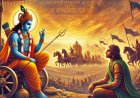
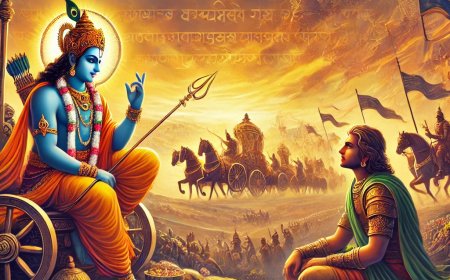
The Bhagavad Gita is a 5000 years old non-religious text that is a dialogue between Lord Krishna and Arjuna on the battlefield of Kurukshetra. It is also known as the Gita or the Song of the Lord.
2. What does the Bhagavad Gita teach?
The Bhagavad Gita teaches that one should live with purity, strength, honesty, and integrity. It also teaches that the soul is immortal and is reborn into another body after death.
3. Who wrote the Bhagavad Gita?
The Bhagavad Gita is attributed to the sage Vyasa, also known as Krishna Dvaipayana or Veda-Vyasa.
4. Can anyone read the Bhagavad Gita?
Yes, the Bhagavad Gita is meant for thinkers of all walks of life and can be read by anyone. There is no prescribed time for reading the Bhagavad Gita, and it can be read whenever you feel comfortable.
5. What is the universal relevance of the Bhagavad Gita?
The Bhagavad Gita, though part of the Mahabharata, addresses universal themes such as duty, righteousness, and the nature of reality. These teachings transcend cultures and time periods, making the Gita relevant to all of humanity.
6. How is the Bhagavad Gita structured?
The Gita is presented as a dialogue between Prince Arjuna and Lord Krishna, his charioteer. This conversational format simplifies complex philosophical concepts, making them accessible and relatable.
7. What paths to liberation does the Gita outline?
he Gita describes multiple paths to spiritual realization, including:
Karma Yoga: The path of action.
Bhakti Yoga: The path of devotion.
Jnana Yoga: The path of knowledge.
These diverse paths highlight that individuals can achieve liberation in ways suited to their nature.
8. Why is the Bhagavad Gita considered timeless?
The teachings of the Gita have influenced leaders and thinkers worldwide, such as Mahatma Gandhi, Albert Einstein, and Carl Jung. Its enduring relevance lies in its profound insights into human nature and the universe.
9. Are there scientific parallels in the Gita's teachings?
Yes, some interpretations of the Gita's concepts, like the nature of the self and the universe, align with modern scientific theories, including quantum physics and consciousness studies.
10. How does the Gita address psychological challenges?
The Gita explores the human psyche, discussing issues like stress, anxiety, and mental clarity. Its teachings resonate with contemporary psychological practices and offer tools for inner peace.
11. Why does the Gita have multifaceted interpretations?
The Gita's depth allows for diverse interpretations, ranging from philosophical and theological to psychological and political perspectives. This richness demonstrates its ability to address various aspects of life and thought.
12. What is the historical context of the Bhagavad Gita?
The Gita was composed between the 2nd century BCE and the 2nd century CE, a period of significant philosophical development in India. It reflects the cultural and spiritual atmosphere of ancient Indian society.
13. What does the Gita teach about action?
One of the Gita's core teachings is to perform one's duty without attachment to the results. This principle of selfless action has influenced various philosophical traditions worldwide.
14. How does the Gita integrate dualities?
The Gita emphasizes the integration of opposites such as joy and sorrow, success and failure. Understanding and transcending these dualities is seen as essential for spiritual growth and inner harmony.
What's Your Reaction?